
What Is Project Fairfax?
Labour's defence spending plans include regional militarisation through defence clusters, but what does this mean for workers and economic identity?

Project Fairfax is a term that’s perhaps unfamiliar to many, largely because it has received relatively little coverage in the media, but it should be of concern to every peace activist and trade unionist.
The stated aim of the project is to establish a defence-technology cluster centred around RAF Wyton, drawing on existing defence infrastructure at RAF Alconbury and RAF Molesworth.
On the surface, it is presented in familiar terms: it will lead to high-skilled jobs, regional growth, and economic renewal. In reality, it represents a significant attempt to expand defence-related economic activity in Huntingdonshire and the wider East of England.
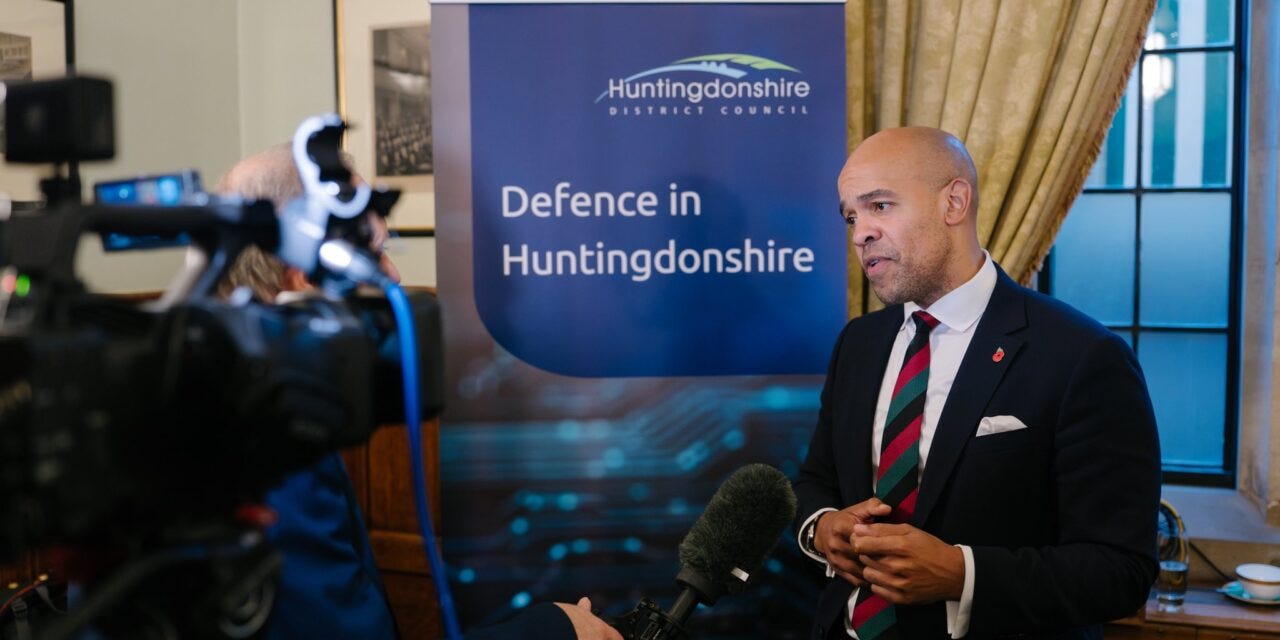
Since its announcement in late October 2025, it has developed into a formal partnership involving Huntingdonshire District Council, the Ministry of Defence, defence sector organisations, academic institutions, and other regional stakeholders.
Although the focus is on areas including defence innovation, intelligence capabilities, geospatial technology, advanced manufacturing, research, and skills development, what elevates Project Fairfax beyond conventional defence investment is the extent to which it has become embedded within local government strategy.
Huntingdonshire District Council’s proposals for local government reorganisation explicitly identify the defence cluster as a strategic priority and argue that their preferred model of a standalone Huntingdonshire unitary authority (Option E) would allow the project to proceed “without being derailed or obstructed by the reform process.” In other words, the debate is no longer simply about attracting defence investment but whether or not local governance arrangements can be designed to support and accelerate that investment.
It’s easy to draw from this the suggestion that local government reform has been undertaken solely to facilitate Fairfax. Although this isn’t the case, local government reform has provided ample opportunity for such projects. All available evidence indicates that the defence cluster has become an important factor in debates about the future structure and capacity of local government in Huntingdonshire.
That should give trade unionists and peace campaigners pause. Local government reform is often publicly presented as a question of efficiency, cost, or administrative boundaries. Yet the Huntingdonshire proposals suggest that governance itself is increasingly being viewed as part of economic strategy. The issue has become not simply who delivers local services, but what kind of economy local institutions are being designed to facilitate and sustain.
Yet the project’s public presentation belies the contradictions under the surface. Much of the modern defence sector is not structured like traditional industry. It is highly automated, heavily dependent on software and data systems, and organised around relatively small numbers of highly specialised roles. This means that very large public investments can produce limited employment gains, while generating substantial returns for private contractors and defence firms.
That is not unique to Fairfax, of course. A government agreement with Palantir in September 2025, described as a “strategic partnership to unlock billions and boost military AI and innovation”, illustrates this dynamic. Palantir has indicated investment of up to £1.5 billion, with the creation of up to 350 jobs. The same level of funding, if directed towards labour-intensive public services, could support vastly greater employment and produce more desirable social outcomes.
Whilst distinct from Fairfax itself, this example demonstrates the capital-intensive nature that characterises much contemporary defence-technology investment, where substantial expenditure can produce relatively limited employment.
This raises questions about the relationship between economic development priorities and public investment. At a time when local authorities and public services continue to face significant financial pressures through cuts and austerity measures, the prioritisation of defence-related growth represents a particular political choice about the direction of regional development.
The wider significance of Project Fairfax lies in what it may represent. Across Britain, defence and security industries are increasingly presented as drivers of innovation, regional investment, and economic resilience. In this context, Huntingdonshire may provide an important example of a broader tendency: the use of defence, intelligence, and strategic technologies as areas of state-supported economic development.
These developments in themselves can be understood as part of a larger pattern in which the state increasingly manages economic pressures through strategic investment in sectors closely linked to state power. Defence industries provide guaranteed demand through public procurement and can attract significant capital investment, but they also risk reinforcing dependence on military and security priorities rather than supporting broader forms of socially useful production.
What we should ask of these developments is this: What happens over time when a region begins to organise its economic identity around defence - when universities and colleges become increasingly integrated into defence research, innovation, and skills partnerships? Local authorities will start to measure success in terms of attracting defence-related investment. Skilled workers find that their future employment is tied, directly or indirectly, to the continuation of military spending.
At that point, militarisation in this, and other forms, is no longer something external to the economy. It becomes part of how the economy is structured. It becomes embedded in the assumptions that shape development itself.
And once that happens, alternatives can become harder to imagine. The same skills, infrastructure and institutions that could be used for other purposes become locked into a single developmental trajectory. The horizon of trade union bargaining becomes tethered to what is compatible with militarism. The question is no longer simply whether we support more or less military spending, but whether entire regions are becoming economically dependent on permanent military priorities.
The development of Project Fairfax also takes place within a broader debate about national priorities. The UK government is increasing defence spending and planning its deployment strategically while many areas of social provision remain under sustained pressure. Local authorities face severe financial constraints; public sector workers continue to experience pay pressures; access to essential services such as NHS dentistry has declined; and many communities face worsening conditions in housing and public infrastructure.
We must interrogate how the state chooses to mobilise resources, and why some priorities are treated as matters of national importance while others are presented as unaffordable.
For decades, working class communities have been told that resources are limited and that difficult choices are unavoidable. Yet significant resources can still be found for strategic priorities determined by the state. The issue is therefore not whether society has the capacity to invest, but whose class priorities shape that investment and whose needs are treated as urgent.
The contrast is particularly stark in the East of England itself. While Project Fairfax is presented as a strategic opportunity for regional employment and investment, workers elsewhere in the region have faced the consequences of financial constraint.
In June 2025, Unite members at Addenbrooke’s Hospital in Cambridge took action against 500 proposed job cuts affecting essential roles across Cambridge University Hospitals. At the same time, commitments were being made by the government for defence spending.
This example invites us to ask a question: What kinds of work and infrastructure are treated as strategic priorities? If investment decisions are a reflection of political choices, then those choices should be judged not only by the jobs they create, but also by the jobs, services and social needs that are left vulnerable.
A similar question arises from a recent FOI response from Cambridgeshire & Peterborough ICB, obtained by Toothless In Huntingdon, which revealed that £16 million in unused NHS dental contract value had been clawed back by the ICB, with around £12 million remaining seemingly unallocated. While this money is not directly connected to defence spending, it does illustrate that tension: the ability to coordinate around strategic priorities while essential public services continue to experience unmet need.
These tensions are not accidental - they again reflect political choices. And that raises a different set of questions. Trade unionists are not against investment or employment, but we are used to asking growth for whom? Jobs on what terms? And who gets to decide the direction of that development?
We must understand Project Fairfax not as an isolated initiative, but as part of an emerging national model of regional development. Across England, Ministry of Defence-backed Regional Defence and Security Clusters are bringing together local authorities, universities, research institutions and industry to embed defence and security within local economic strategies. What distinguishes Fairfax is not that it exists, but the unusual clarity with which its relationship to local government restructuring has been expressed.
And that is exactly why we need to connect what is happening now to a longer tradition of working class thinking about production and democracy.
The concern of alternatives requires us to think differently about what security means. The Alternative Defence Review, developed by the Campaign for Nuclear Disarmament, challenges the assumption that security is primarily a question of military capability. Instead, it argues that genuine security depends on the resilience of society itself: secure employment, decent housing, strong public services, environmental stability and international cooperation.
This isn’t an argument that security in terms of defence is unimportant - we still live in a world where it is needed to some degree. Rather, it is an argument that security has been defined far too narrowly. A society weakened by poverty, declining public services and economic insecurity is not made secure simply by increasing its military capacity.
That also applies to industrial policy. If security is understood only through the lens of defence, then skills, technology and investment will naturally be directed towards military priorities. But if security is understood as a social condition, then the same resources can be directed towards meeting wider human needs, strengthening us socially.
The question is not simply how much we spend on defence, but what we understand defence and security to mean.
This is the lesson of the Lucas Aerospace workers’ plan of the 1970s. Faced with military production and economic uncertainty, workers did not simply defend existing jobs; they demonstrated that those same skills and capabilities could be directed towards socially useful production. Their argument was not against technology or industry, but for democratic control over the purposes to which they are put.
Project Fairfax raises a question that goes beyond one development project or one region. It asks what we mean by security, and who gets to define it. At present, that definition is increasingly shaped by governments, defence institutions and private contractors - by the class above our own. But workers and communities possess the knowledge, skills and democratic capacity to argue for something different: a society where security is measured not by the scale of military capability alone, but by the strength of public life.
Project Fairfax is more than simply a local development proposal - the Ministry of Defence and Huntingdonshire District Council has now signed it off. It is part of a wider argument about what kind of economy Britain is building, what we mean by security, and who should have the democratic power to decide.
The task now is to connect these debates with workplaces, trade unions, and communities, so that opposition to militarisation becomes more than protest alone.